You're probably in a familiar buyer loop right now. You can compare GPUs in five tabs, tell the difference between a Hall effect keyboard and a membrane board, and you know when a spec sheet is hiding compromises. But when you start looking at Swiss watches, the category gets foggy fast. Terms like automatic, Powermatic, sapphire, COSC, and antimagnetic get thrown around like everyone already knows the map.
That's where Tissot makes sense.
For a lot of tech-minded buyers, Tissot watches sit in the same lane as a well-chosen enthusiast peripheral. Not the cheapest option, not the status flex tier, but a product class where engineering choices affect ownership. You're not only buying a logo. You're choosing a movement architecture, a case material, a crystal type, a service path, and a long-term support story.
Table of Contents
- Introduction to Tissot Watches for Modern Tech Buyers
- How Tissot Became a Swiss Watch Powerhouse
- Understanding Tissot Movements and Core Technology
- How WatchClick Can Help
- Exploring Main Tissot Collections and Hallmark Models
- How to Choose the Right Tissot for Your Lifestyle
- Authenticity Warranty and Servicing Essentials
- Where to Buy Your Tissot Safely and Confidently
Introduction to Tissot Watches for Modern Tech Buyers
A first serious watch often starts the same way as a first mechanical keyboard. At first, all you want is “something good.” Then you notice build materials, switch feel, firmware support, repairability, and whether the premium is paying for performance or just aesthetics.
Tissot is useful because it gives you a Swiss watch brand with a long technical track record, but it usually presents that engineering in a way that doesn't require collector-level knowledge to appreciate. If you've ever upgraded from a basic mouse to a shape that fits your grip and changes how everything feels day to day, you already understand the appeal.
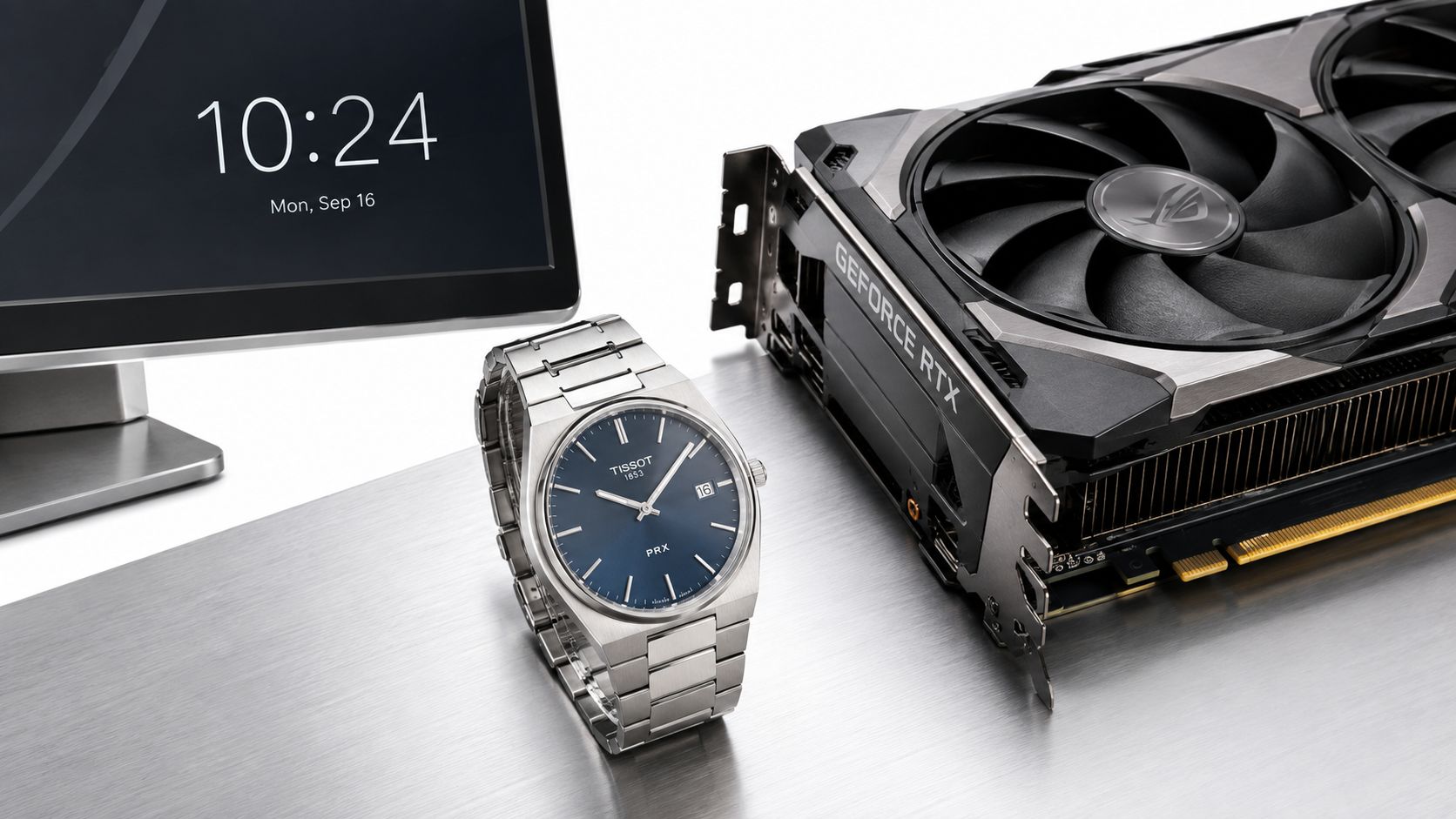
Why Tissot clicks with hardware-minded buyers
Tissot watches are easy to dismiss as “entry Swiss.” That undersells what's going on. The better lens is this: Tissot often works like a mainstream hardware brand with real in-house ecosystem advantages. You get broad distribution, familiar model lines, and parts and service logic that usually make more sense than gambling on a microbrand with a nice render and weak after-sales support.
That makes Tissot a practical bridge between fashion watches and deeper watch enthusiasm.
A lot of shoppers also come in from the smartwatch side. If that's you, it helps to compare your expectations against a broader smartwatch buying guide before deciding whether you want notifications on your wrist or whether you mainly want a durable object that tells time beautifully for years.
Practical rule: If your instinct is to compare watches the way you compare laptops, start with platform questions first. Quartz or mechanical, dressy or sporty, low-maintenance or hobby object.
What confuses first-time buyers
Most confusion comes from mixing three different questions:
- Movement question: Do you want quartz convenience or mechanical character?
- Use case question: Is this for daily wear, office wear, sport, travel, or collecting?
- Ownership question: Are you prepared for servicing, warranty registration, and authenticity checks?
People often answer only the style question.
That's how someone ends up buying a great-looking watch with the wrong movement for their habits, or getting lured by a discount listing that creates support problems later. With Tissot, the smart buy usually comes from reading the watch like you'd read a motherboard spec sheet. Ignore the marketing layer for a minute. Look at the architecture, compatibility, durability, and maintenance path.
The right way to think about this brand
Tissot isn't trying to be obscure, artisanal, or ultra-luxury. Its strength is different. It gives you scale, heritage, recognizable design lines, and movement options that range from easy daily quartz to enthusiast-friendly mechanical models.
That combination matters because watches aren't only accessories. They're long-life devices worn in a harsher environment than most gadgets. Sweat, knocks, rain, magnetism, desk impacts, and neglect all show up eventually. A good watch handles that without becoming a chore.
How Tissot Became a Swiss Watch Powerhouse
You see a Tissot in a department store, on a watch forum, and in enthusiast collections, all at very different prices. That usually means one thing. The company solved manufacturing and distribution early, then kept adapting as the product itself changed.
That history matters because it explains why Tissot feels less like a tiny boutique brand and more like a mature hardware maker with a long product roadmap.
Tissot scaled early, and that shaped the brand
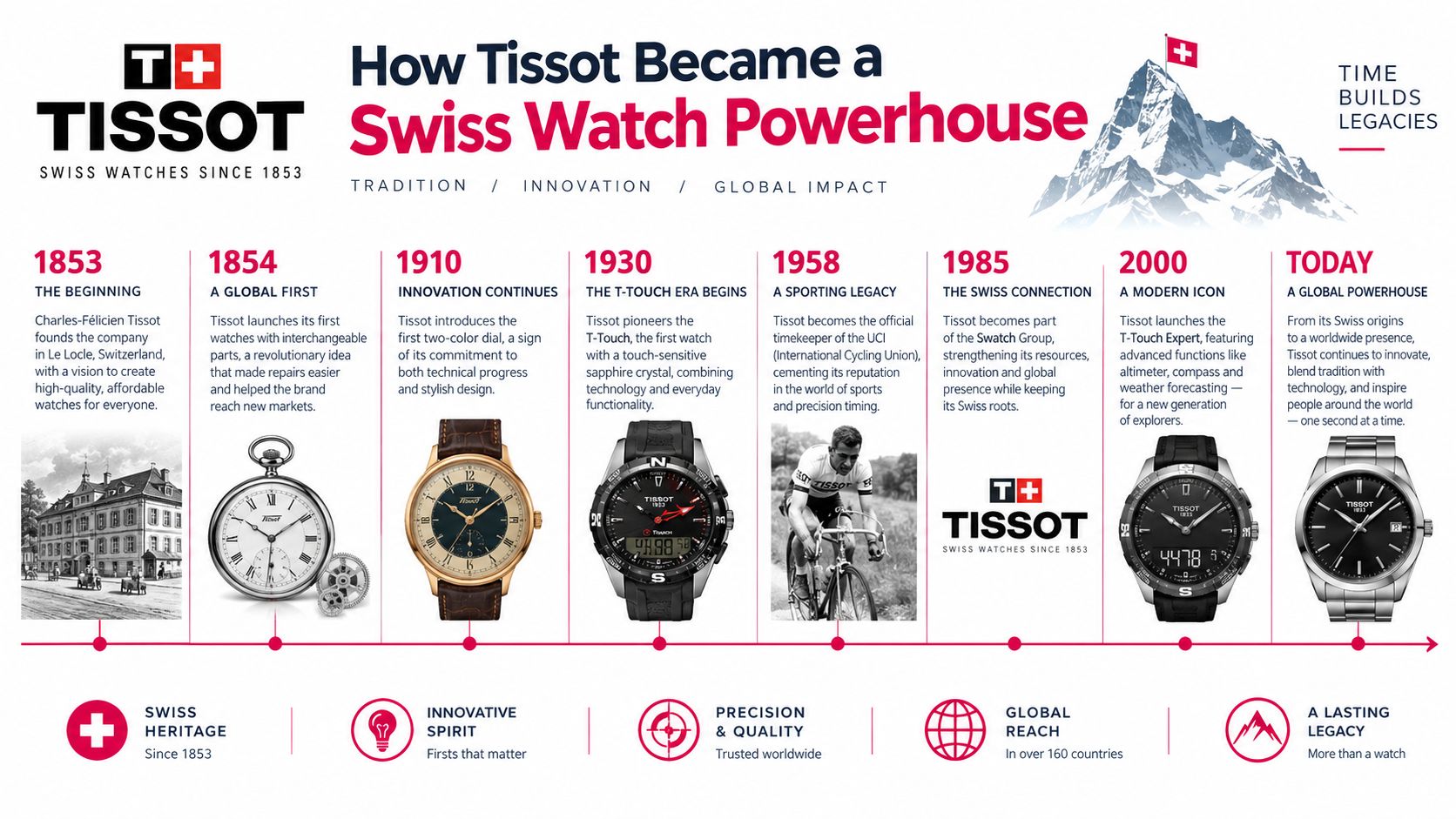
Tissot was founded in Le Locle, Switzerland, in 1853. In that same year, the brand is credited with introducing the first mass-produced pocket watch and the first pocket watch with two time zones, according to Tissot's historical overview. Those are not just trivia points. They show an early focus on making useful watches in repeatable volume.
For a tech buyer, the closest comparison is a company that did not stay in pure prototype mode. It built for production. That changes quality control, parts consistency, and long-term support.
The company adapted when the platform changed
Tissot later built its first factory in 1907 and moved into industrial series production of wristwatches by 1920. That shift matters for the same reason a hardware company's move from one platform to the next matters. Pocket watches were the old format. Wristwatches became the dominant one, and Tissot made that transition at scale.
A lot of watch brands can point to age. Tissot's advantage is that its age connects to production know-how, not just storytelling.
The brand also built a record of practical technical firsts. The Pilot Watch's brand profile credits Tissot with the first antimagnetic wristwatch in 1930, the first mass-produced watch with 24 time zones in 1953, and the T-Touch in 1999. Read as a pattern, those milestones show a company that kept testing new features instead of relying only on heritage styling.
Here's the short version:
| Milestone | Why it matters |
|---|---|
| 1853 founding in Le Locle | Establishes deep roots in Swiss watchmaking |
| First mass-produced pocket watch | Shows an industrial approach from the start |
| Two-time-zone pocket watch | Adds function, not just decoration |
| 1907 first factory | Supports larger-scale manufacturing |
| 1920 wristwatch series production | Proves Tissot could adapt to a new form factor |
| 1930 antimagnetic wristwatch | Addresses a real reliability problem |
| 1953 mass-produced 24-time-zone watch | Extends travel functionality |
| 1999 T-Touch | Brings interface experimentation into the modern era |
A short visual history helps connect those milestones to the products you still see on shelves today.
Why that scale still matters to buyers now
Tissot's current market position comes from infrastructure. Large production capacity means the brand can support dress watches, sport watches, quartz models, and mechanical models without feeling scattered. It also helps explain why the catalog is broad, parts and servicing are easier to plan for than with many smaller brands, and model lines stay recognizable over time.
That last point gets missed by first-time buyers.
A watch is not only a style purchase. It is also a long-term ownership decision. A brand that has spent decades building at volume usually gives you a clearer warranty path, more established servicing networks, and fewer surprises around authenticity checks and replacement support. That does not make every Tissot the best option. It does make the ownership math easier to predict.
What this means for a buyer
Tissot's main strength is not mystique. It is the combination of Swiss heritage, industrial discipline, and broad support after the sale.
For gamers and PC builders, the easiest analogy is this. Some brands feel like niche enthusiast hardware with limited stock, patchy support, and uncertain upgrade paths. Tissot feels more like a proven platform from a major manufacturer. You may give up some rarity, but you usually get better consistency, easier servicing, and a safer buy if you care about total ownership cost, not just the dial photo.
Understanding Tissot Movements and Core Technology
You spot two Tissot watches with similar cases, similar dials, and a similar price. One needs little attention for years. The other asks for periodic servicing, may drift a bit more day to day, and gives you a different kind of satisfaction every time you set it. The difference is the movement.
If the case is the PC tower, the movement is the chipset, clock source, and power system working together. It decides how the watch keeps time, how it stores energy, and what ownership will feel like after the first week of excitement.
Quartz versus automatic in plain English
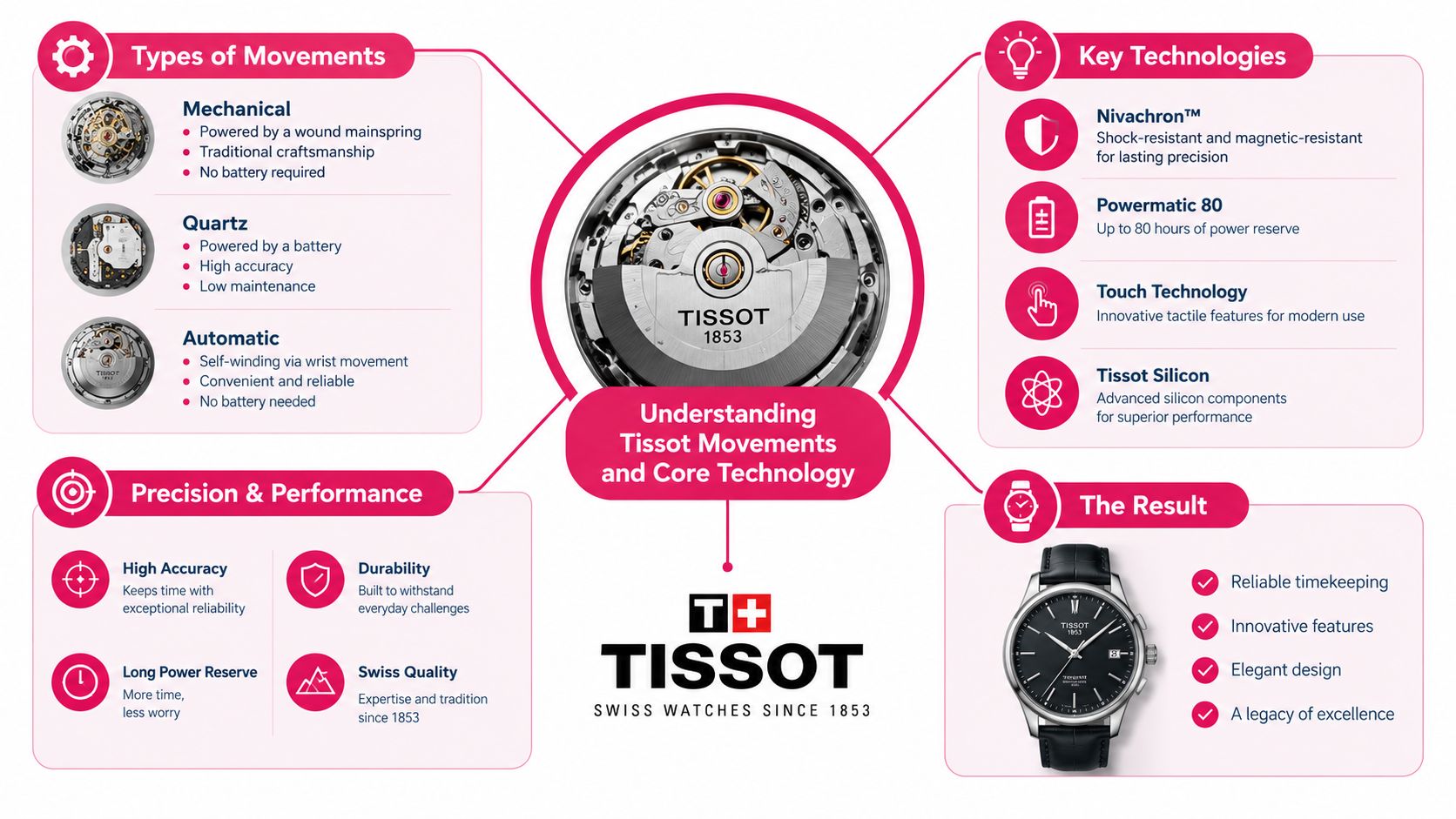
A quartz Tissot works like a reliable appliance. A battery powers the watch, an electronic circuit regulates timekeeping, and your job is mostly to replace the battery when needed. For buyers who want accuracy and low maintenance, quartz is usually the practical answer.
An automatic Tissot is mechanical. It stores energy in a mainspring and rewinds itself through wrist motion. That gives it enthusiast appeal in the same way a custom mechanical keyboard or air-cooled build does. You can see the engineering, feel the interaction, and accept a bit more upkeep as part of the ownership experience.
Neither option is the universal winner. They fit different use cases.
If you know connected devices better than traditional watches, the contrast makes more sense after reading how a smartwatch can function without a smartphone connection. Smartwatches focus on features and connectivity. Mechanical watches focus on self-contained engineering. Quartz is the low-friction middle ground for buyers who care more about function than ritual.
Reading a movement spec sheet
A watch spec sheet gets easier once you translate the terms into hardware logic.
- Power reserve: the watch's stored runtime when you are not wearing it. For an automatic, this is battery life in mechanical form.
- Beat rate: how fast the regulating system oscillates. Higher is not automatically better, but it affects how the seconds hand moves and how the movement is tuned.
- Jewels: low-friction bearings placed at wear points inside the movement.
- Hacking seconds: the seconds hand stops when you pull the crown, which helps if you want precise time setting.
- Hand-winding: you can add power manually through the crown.
- Antimagnetic hairspring: added protection against magnetic fields from daily electronics.
New buyers often lock onto power reserve because it is easy to compare.
That helps, but it is incomplete.
Judging a movement only by power reserve is like buying a handheld gaming device only by battery capacity. You still need to care about efficiency, tuning, durability, and how the device behaves in daily use.
Powermatic 80 is the Tissot movement many buyers start with
Among Tissot mechanical watches, Powermatic 80 is the name that comes up most often. It gets attention because it offers longer runtime than many entry-level Swiss automatics, and it does so through an understandable trade-off.
The movement traces back to the ETA 2824 architecture, but Tissot and its group use a lower beat rate to reduce energy consumption and stretch runtime to about 80 hours, as explained in Caliber Corner's Powermatic 80 breakdown. The hardware analogy is simple. This is similar to tuning a processor for efficiency instead of chasing the highest possible clock speed.
That trade-off matters in real life. A longer reserve means you can take the watch off for a day or two and come back to a running watch. If your rotation includes several watches, or you do not wear the same one every weekend, that convenience is easy to appreciate.
Powermatic 80 also appears in more than one form, which is where beginners can get confused. The family can include features such as hacking seconds, hand-winding, and in some versions a Nivachron hairspring for better magnetic resistance, all under the same broad movement label. That is why the name alone is not enough. Like a GPU family or CPU generation, the platform tells you the baseline, but the exact implementation still affects the final experience.
What the numbers do and do not tell you
Magnetic resistance sounds abstract until you remember how much desk gear surrounds a modern owner. Laptops, tablets, wireless chargers, speakers, and headphones all live close to your wrist. You do not need to treat magnetism as a crisis, but better resistance can reduce one common annoyance of mechanical ownership.
Accuracy works the same way. Two watches can share the same movement family and still be adjusted to different standards. So read movement labels as a starting point, not as the whole story.
That is also where ownership cost enters the picture. Mechanical watches can be rewarding, but they are not zero-maintenance devices. More moving parts means eventual servicing matters more than it does with quartz, and that servicing cost should sit next to the purchase price in your mental spreadsheet.
Case and crystal specs shape daily use
Beginners often focus on the movement and ignore the parts they will interact with every day. That is backwards.
Case metal, crystal type, crown action, and water resistance determine whether a watch feels like a daily tool or a fragile desk object. Tissot commonly uses 316L stainless steel cases and scratch-resistant sapphire crystal in core models such as the Le Locle Powermatic 80, as shown on Tissot's Le Locle product page. Those choices matter for practical reasons.
- 316L steel handles normal daily wear well and resists corrosion.
- Sapphire crystal is far more scratch-resistant than the mineral crystal used on cheaper watches.
- Exhibition casebacks, when included, let you inspect the movement and make the mechanical side of the watch easier to appreciate.
Water resistance deserves special attention because spec sheets can mislead new buyers. Dressier Tissot models may offer only basic splash resistance, while many sport-oriented references are built for much more active use. Always read that line before you assume one Tissot can do everything.
The right way to choose between Tissot movement types
Start with operating model, not dial color.
Choose quartz if you want accuracy, low fuss, and the simplest ownership path. Choose automatic if you want visible engineering, mechanical character, and you are comfortable budgeting for eventual service. If you are looking at a Powermatic 80 model, treat the long reserve as one advantage, not as the only advantage. Then check the full package: crystal, case material, magnetic resistance, water resistance, warranty coverage, and whether the seller gives you a clear authenticity and service path.
That last part matters because a watch is hardware you wear for years. Good specs are only half the value. The other half is how easy the watch is to own, verify, and maintain after the purchase.
How WatchClick Can Help
Buying Tissot watches gets easier once you narrow the field by use case, but shoppers still hit the same friction points. Which retailers show enough detail? Which stores carry both quartz and automatic options in one place? Which sellers feel built for comparison rather than impulse buying?
That's where a curated online retailer can be more useful than a marketplace listing.
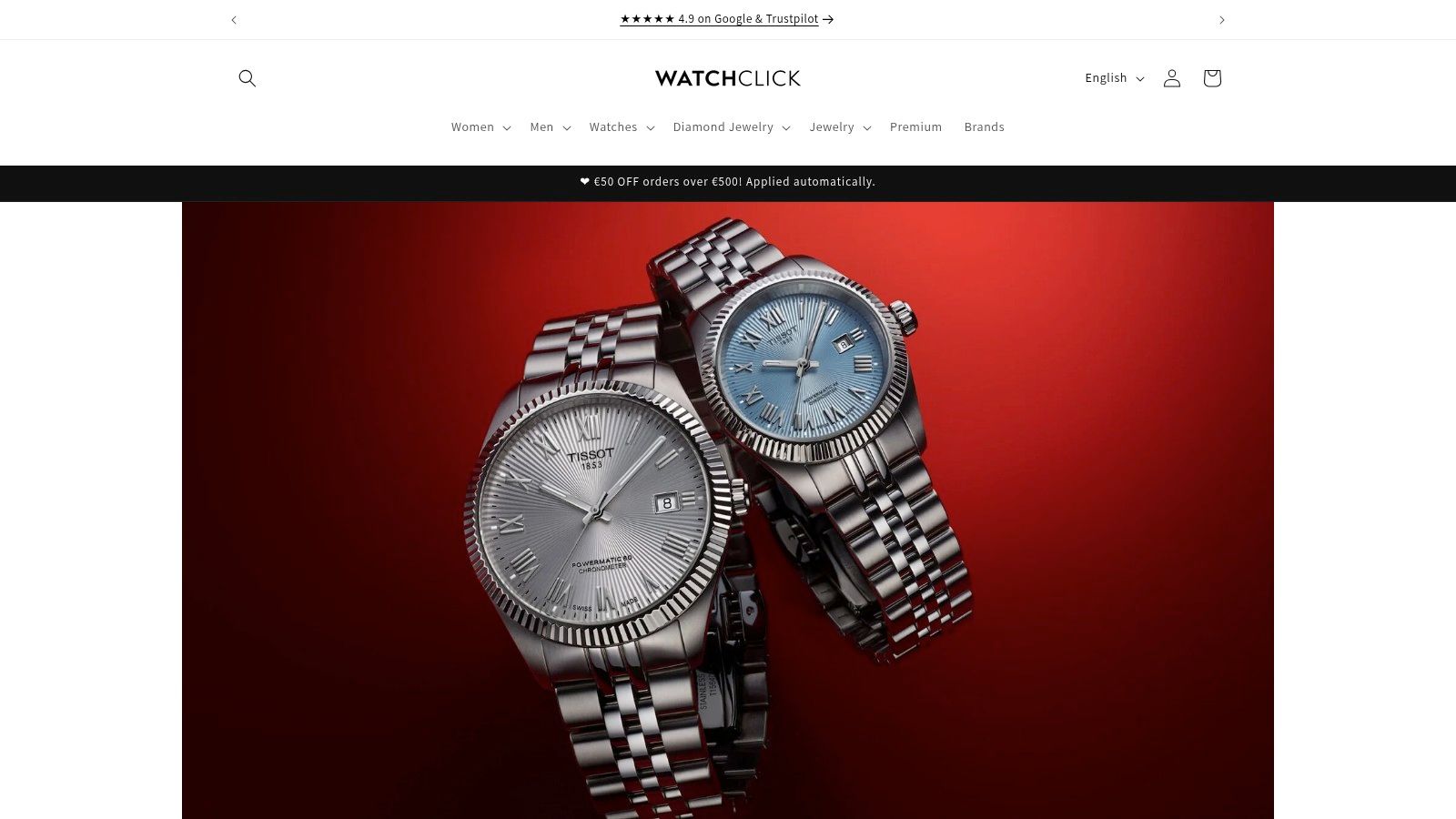
WatchClick is an online store focused on premium watches and jewelry, with a broad catalog that spans Swiss brands, Japanese brands, fashion labels, and accessories. For a Tissot buyer, the useful part isn't just brand access. It's that you can compare dressier and sportier directions without jumping between disconnected storefronts.
If you're browsing montres Tissot, the value is mostly practical:
- Category breadth: You can compare Tissot against brands like Longines, Oris, Citizen, Casio, and Orient in one shopping environment.
- Movement variety: Quartz and automatic models sit side by side, which helps if you're still deciding how much maintenance you want.
- Material filtering: Leather straps and metal bracelets are easy to separate when comfort matters as much as appearance.
- Buying comfort: WatchClick presents itself around secure checkout, clear returns, and an authorized-retailer mindset, which is what many buyers care about most online.
A store like this is the right choice when you already know your constraints but want a cleaner comparison flow. Maybe you know you want Swiss, maybe you know you want a bracelet, or maybe you're shopping for a gift and need a retailer that also handles jewelry categories without feeling random.
It's less ideal if you still need hands-on sizing before deciding. In that case, a local authorized dealer can still beat any website.
Exploring Main Tissot Collections and Hallmark Models
Shopping Tissot by collection works better than shopping by random reference numbers. It is a lot like comparing PC parts by category first. You sort GPUs, CPUs, and motherboards before you compare individual SKUs. Tissot's range gets easier once you sort it into a few clear buckets: design-led everyday watches, classic dress pieces, sport models, and the connected outlier.
That approach also helps you avoid a common first-buyer mistake. A watch can look great in isolation and still be the wrong platform for your actual use. Collection names are useful because they tell you what Tissot was optimizing for in the first place.
The style-first collections
PRX is the easiest collection to recognize. Its integrated-bracelet case shape has the same appeal as well-finished hardware with sharp edges and clean surfaces. If you like minimalist desk setups, metal-bodied peripherals, or industrial product design, the PRX often clicks immediately. It comes in quartz and automatic versions, so you can pick between lower-maintenance ownership and more mechanical charm.
Le Locle moves in the opposite direction. It is less about sharp geometry and more about traditional Swiss dress-watch language. Roman numerals, textured dials, and a softer overall look give it the feel of a classic interface rather than a modern redesign. Buyers who want something formal and less trend-sensitive usually start here.
Ballade sits nearby, but with a slightly more spec-aware personality. It still reads as dressy, though it often attracts people who care about finishing, movement choice, and the details that make a watch feel more substantial on the wrist.
The practical and sporty side
Gentleman is one of Tissot's safest recommendations because it behaves like a well-balanced midrange build. Nothing about it is too specialized. It can work with office clothes, casual wear, and travel without looking out of place. For many buyers, that matters more than having the most distinctive case shape in the catalog.
Seastar is the collection for buyers who want a clearer tool-watch identity. Bezels are more assertive, cases are usually more substantial, and the whole watch gives off a purpose-built vibe. For a tech audience, it is closer to a rugged gaming laptop than a thin ultrabook. Less subtle, more ready for rougher use.
Chemin des Tourelles sits in a more traditional lane, but it usually shows its mechanical character more openly than a very restrained dress watch. It suits buyers who want classic proportions, visible watchmaking cues, and a watch that feels dressy without feeling fragile.
The connected outlier
T-Touch Connect Sport is the one collection that speaks directly to smartwatch cross-shoppers. It makes the most sense for buyers who want tracking and connected functions but still care about traditional watch-brand identity.
That said, a lot of hardware-minded buyers end up preferring a conventional Tissot after comparing the ownership trade-offs. A connected watch adds features, but it also adds another update cycle, another charging habit, and another long-term support question. Quartz and automatic models do less, yet they often age better.
Collection cues that matter more than they first appear
A Tissot collection is not just a style label. It also hints at how the watch will wear, how much visual presence it has, and what kind of long-term ownership experience you are signing up for.
A PRX wears like a design object first. A Gentleman usually behaves like the safe all-rounder. A Seastar tends to bring more size, more visual weight, and a more specialized feel. A Le Locle or Chemin des Tourelles asks for different use cases, closer to formalwear or quieter daily wear.
That matters because ownership cost is not only about the purchase price. More complex mechanical pieces can bring higher service costs later. Connected models raise different questions about battery systems and software longevity. Quartz references are often the simplest to live with if you want the watch equivalent of stable plug-and-play hardware.
Tissot collections at a glance
| Collection | Signature Style | Movement Options | Best For |
|---|---|---|---|
| PRX | Angular integrated-bracelet design | Quartz and automatic | Buyers who want a modern, design-forward everyday watch |
| Le Locle | Traditional Swiss dress look | Often automatic-focused in enthusiast discussion | Office wear, formal use, classic styling |
| Ballade | Refined and polished | Quartz and mechanical depending on reference | Dressier buyers who still care about specs |
| Gentleman | Versatile all-rounder | Quartz and automatic | One-watch owners who want flexibility |
| Seastar | Sport and dive-inspired design | Varies by reference | Buyers who want Tissot's more overtly capable sport direction |
| Chemin des Tourelles | Refined classic mechanical feel | Commonly mechanical in enthusiast interest | Buyers wanting traditional elegance with substance |
| T-Touch Connect Sport | Connected hybrid approach | Connected electronic platform | Users who want smart features in a premium watch context |
A good shortlist usually includes three different answers to three different questions: the one you like looking at most, the one that best fits your real routine, and the one you will still be happy to own after warranty, servicing, and maintenance enter the picture.
How to Choose the Right Tissot for Your Lifestyle
A lot of buyers ask the wrong question first. They ask, “Which Tissot is best?” The better question is, “Which Tissot will still make sense after the novelty wears off?”
That's where watch buying starts to resemble monitor buying. The “best” spec sheet can lose if it doesn't fit how you use the thing.
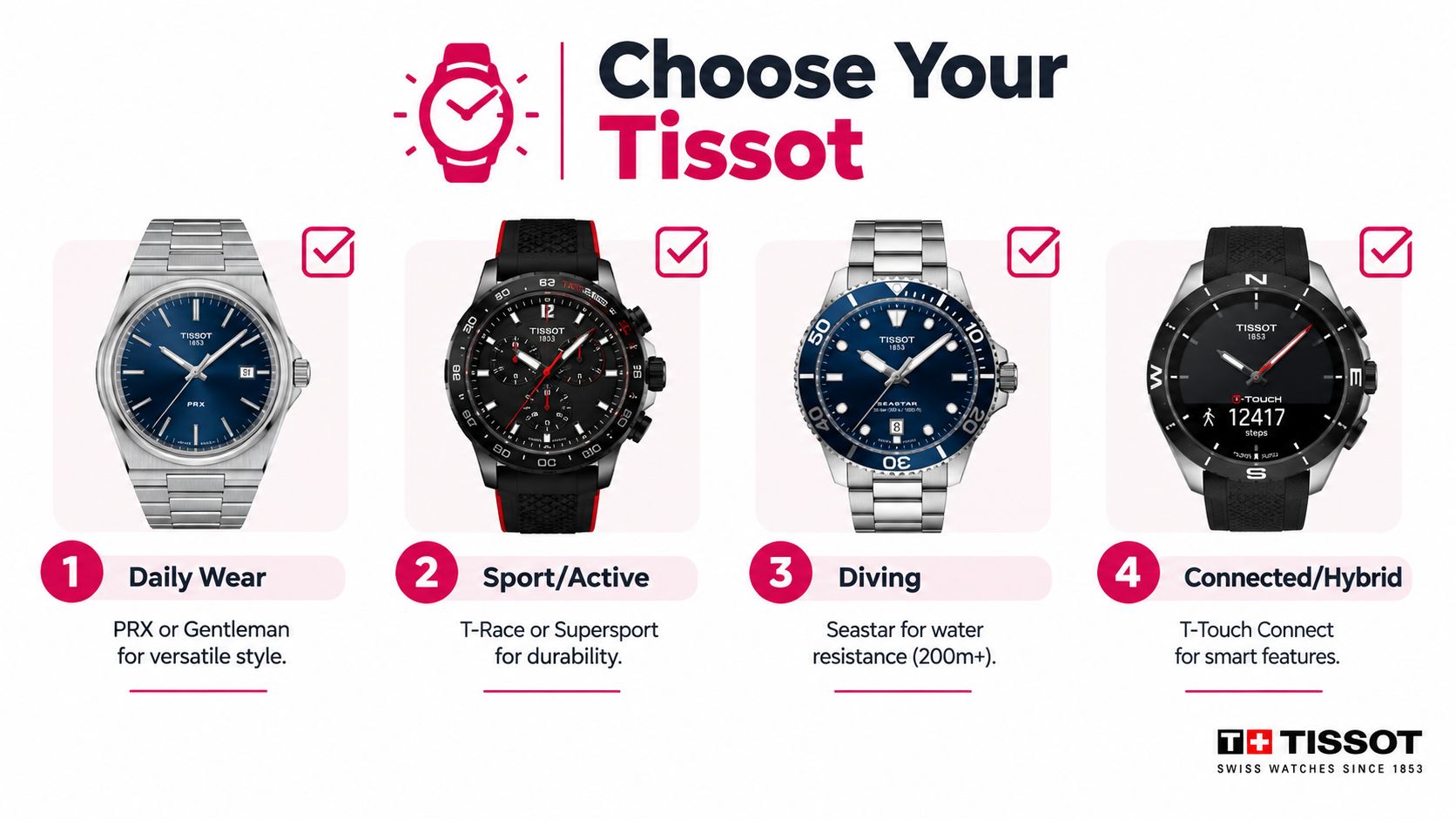
Start with your real daily loop
If your day is mostly desk work, commuting, casual clothes, and occasional nicer settings, don't overbuy for edge cases. A versatile everyday model will make more sense than a heavy sport watch you rarely need.
If your routine includes gym sessions, travel, frequent weather exposure, or you just prefer a more rugged aesthetic, sportier Tissot watches become easier to justify.
For buyers cross-shopping against wearables, it also helps to think through whether a standalone connected watch is what you really want. Some people assume “tech person equals smartwatch person.” In practice, plenty of tech people end up preferring a conventional watch because it asks less from them.
Four buyer profiles that usually work
Here's a practical decision matrix.
- The one-watch owner: Choose something versatile, bracelet-friendly, and not too specialized. PRX or Gentleman usually fit this mindset.
- The formal lean buyer: Go toward Le Locle, Ballade, or Chemin des Tourelles if shirts, blazers, or understated styling dominate your wardrobe.
- The active user: Pick a sport-oriented line where water resistance and tougher styling make daily knocks less stressful.
- The connected experimenter: Consider T-Touch Connect Sport only if smart functions matter enough that you'll use them.
The mistake is buying for fantasy use. Lots of people buy a dive-styled watch because it looks capable, then wear it only at a desk. That's fine if the look is the point. It's less fine if comfort or thickness starts annoying you.
Mechanical charm versus low-friction ownership
The "cheap Swiss" myth starts to break down here. An affordable Swiss watch isn't automatically cheap to own forever.
Quartz tends to be simpler to live with. Mechanical models offer richer engineering and enthusiast appeal, but they ask for more attention over time. That doesn't make them bad value. It means the sticker price isn't the whole story.
Questions worth asking yourself:
| Your preference | Better fit |
|---|---|
| You want grab-and-go convenience | Quartz |
| You enjoy visible mechanics and movement talk | Automatic |
| You rotate watches and may leave one unworn | Long power reserve automatic can help |
| You hate maintenance appointments | Quartz is usually safer |
| You want a wearable tech feel | Connected model |
Size, bracelet feel, and comfort are not minor details
A watch can be technically excellent and still lose because it wears badly on your wrist. Comfort issues show up the same way they do with mice, headsets, or controllers. You don't always notice them in the first ten minutes. You notice them after three hours.
Pay attention to:
- Case shape: Integrated-bracelet designs can wear differently from standard cases.
- Bracelet versus strap: Metal bracelets feel premium to many buyers, but leather or rubber may fit your routine better.
- Dial legibility: Some watches look amazing in product photos and feel busy in daily use.
- Weight balance: Heavier isn't always better.
Buy for the life you already have. Don't buy a watch that requires your habits to change unless becoming a watch hobbyist is the goal.
The best chooser's mindset
A good Tissot pick usually happens when three things line up. You like the design, the movement matches your tolerance for maintenance, and the watch fits your actual schedule.
If one of those is off, you'll feel it later.
Authenticity Warranty and Servicing Essentials
You buy a Tissot online, unbox it, size the bracelet, and wear it for a week. Then a question hits you: if something goes wrong, do you have a clean support path or a small logistics project?
That question matters as much as the dial color.
For a tech buyer, ownership is never just the device. It is the warranty flow, parts support, repair turnaround, and whether the seller set everything up properly on day one. Watches deserve the same scrutiny. A good Tissot purchase is not only about the movement. It is also about the support stack behind it.
What the warranty terms mean
Tissot says warranty activation is digital, standard coverage is 2 years, some Lightmaster Solar and COSC models get 3 years, full servicing is recommended every 4 to 5 years, and spare parts are guaranteed for at least 10 years after production ends, according to Tissot's FAQ.
Read that like a hardware spec sheet.
The warranty is your support window. The service interval is your maintenance cycle. Parts availability is long-term repairability. If you are used to evaluating laptops, GPUs, or phones, the logic is familiar. The difference is that a watch can stay in rotation for far longer, so support details carry more weight.
Digital activation deserves extra attention. Treat it like product registration tied to your serial and seller record. If the retailer is vague about how activation works, that is a warning sign. You want confirmation that the purchase is properly logged, not a loose promise that the box includes paperwork.
Why servicing changes the value equation
Many first-time buyers misread the price.
A quartz Tissot can feel closer to a low-maintenance appliance. A mechanical Tissot is closer to a performance device with scheduled upkeep. It may keep running for years, but that does not erase the service cycle. Oil ages. Seals wear. Accuracy can drift. None of that means the watch is weak. It means the machine is mechanical.
For gamers and PC builders, the analogy is simple. Buying an automatic watch and expecting zero upkeep is like building a high-end desktop and acting surprised that dust cleaning, thermal maintenance, and the occasional part check exist. The ownership cost is still reasonable. It just is not zero.
This matters when comparing value. A discounted purchase price can stop looking like a bargain if the support path is messy or the next service feels inconvenient.
Authenticity checks that help
You do not need expert-level watch knowledge to avoid a lot of bad outcomes. Start with the sales process.
- Seller credibility: Prefer authorized sellers or established retailers with a clear business identity.
- Digital warranty setup: Ask how activation is handled and when it is completed.
- Documentation match: Model details, packaging, and seller records should agree with each other.
- Return policy: Read it before paying, not after a problem shows up.
- Service route: Ask who handles future battery changes, repairs, or warranty claims.
These checks work because they test the whole ownership chain, not just the object in the box. A fake or problematic watch often comes with a weak paper trail, fuzzy warranty answers, or evasive return terms.
The ownership costs buyers notice late
Servicing, battery replacement, and repair logistics are common friction points in this category, not a Tissot-specific defect. The lesson is simple. The cost of ownership includes time, convenience, and support quality, not just the checkout price.
That is why authenticity and servicing belong in the same conversation. A genuine watch from a shaky seller can still create a poor ownership experience. A modest discount can also lose its appeal fast if warranty handling is unclear or routine service becomes a hassle.
A watch can be a strong value on day one and still become irritating later if the support path is slow, confusing, or inconvenient.
A sensible owner checklist
Before you buy, make sure these answers are clear:
- I know whether this Tissot is quartz, automatic, solar, or connected.
- I understand what routine upkeep this type of watch will need.
- I know how the digital warranty will be activated and recorded.
- I trust the seller to help if there is a problem after delivery.
- I am judging the ownership path, not just the product photos.
If you can answer yes across the board, you are not just choosing a watch well. You are choosing the support system around it well too.
Where to Buy Your Tissot Safely and Confidently
The safest buying channel depends on your risk tolerance more than your taste. Some buyers want the cleanest possible ownership path. Others are willing to trade certainty for price flexibility. The problem is that a watch discount can hide support compromises that don't show up until later.
That's why the buying channel matters almost as much as the watch itself.
The safest options first
Authorized dealers are the low-drama route. You're more likely to get a clean warranty process, straightforward authenticity confidence, and a clear answer when you ask who handles problems later.
Brand boutiques or official brand channels can be even simpler if you want maximum clarity. They're rarely the most adventurous option, but they reduce ambiguity.
For many first-time Tissot buyers, that's worth a lot.
Online retailers can be excellent if they're transparent
A good online retailer should make a few things obvious without you needing to dig:
- Who they are
- How returns work
- How warranty support works
- What condition the watch is in
- Whether they're operating as an authorized seller
If those answers are fuzzy, move on. Watches aren't like buying a commodity USB cable. The support path matters too much.
Secondhand and grey market need a cooler head
Secondhand buying can be attractive if you enjoy research and don't mind extra verification work. But it's not where most first-time buyers should start.
Grey market can also look tempting because the listing appears legit and the watch is real. The catch is often support. If the warranty chain is broken or unclear, a lower upfront cost may not stay lower once service or repairs enter the picture.
That trade can still make sense for an experienced buyer. It usually makes less sense for someone buying their first serious Swiss watch.
Final buying checklist
Before you click buy, confirm these points:
| Check | Why it matters |
|---|---|
| Seller status is clear | Reduces authenticity and warranty uncertainty |
| Return policy is written clearly | Protects you if sizing or condition disappoints |
| Warranty activation is understood | Prevents post-purchase support confusion |
| Model specs match your use | Avoids buying a good watch for the wrong job |
| Future service path is known | Turns a nice purchase into a manageable long-term one |
Tissot watches make the most sense when bought with the same discipline you'd apply to a GPU, headset, or premium keyboard. Read the spec sheet. Understand the support model. Ignore hype. Buy the version that fits your routine, not the version that wins the loudest comments.
If you want more buying guides written for people who compare products like hardware, keep an eye on Macfay Hardware, where tech purchases get judged the way they should be: by real use, trade-offs, and long-term value.